
landscape / maps of the mind
By Jané E Mackenzie
I could show you my homeland on a map and you would see the names of hills to climb and beaches to visit, but for me some of the best bits, in my experience, are vague patches of nothing on your average map. Places where you will find sheep paths, extra-squishy green bog, bracken higher than your head, and a big rock to watch a sky that is never the same colour twice. It is not surprising, given the context I grew up in, in the northwest of the Highlands, that landscape has always played a huge part in my creative practice.
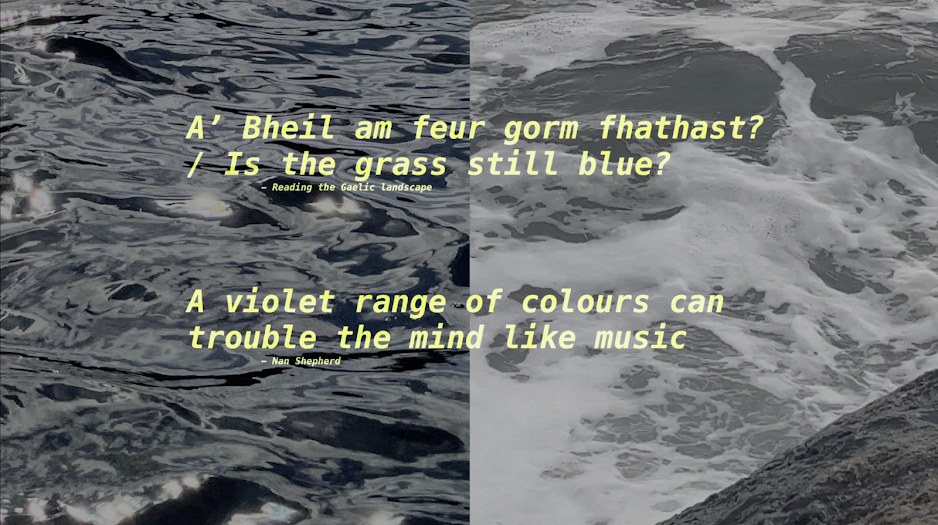
It is said that there are over 60 words for mountains in Gaelic. Landscape and Gaelic are in some way entwined, such as in the understanding of colours, which in Gaelic is beyond a hue but “distinguished by a changing landscape”.
A’ bheil am feur gorm fhathast? / Is the grass still blue?
John O’Donohue, an Irish poet whose practice was also often anchored in landscape, said:
“…one of the recognitions of the Celtic imagination — that landscape wasn’t just matter, but that it was actually alive. What amazes me about landscape, landscape recalls you into a mindful mode of stillness, solitude, and silence, where you can truly receive time.”
The desire/inability to capture the full aliveness of land, and yet continue to map it, is part of its appeal in my creative practice. Gaelic isn’t my native tongue, despite its heavy imprint on the places and people I grew up with. So it has been a wonder to read about Gaelic’s relationship to the land and to discover how this tongue, and its songs and poems, expand to me a place already known in new ways. As native speaker, John Murray, who has written two books on this topic states:
“All maps, whether drawn or not, are the product of priorities and preferences, both individual and societal. But cognitive maps confirm patterns of relative importance and patterns of movement and are understood and used by those who conceive them.”
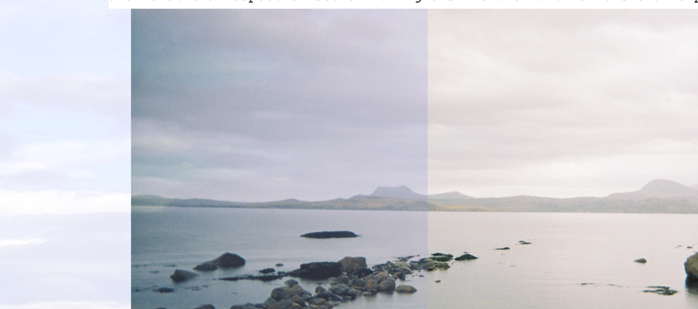
Part of Gaelic’s erasure came through viewing the land as a means of economic gain / a commodity, as people were cleared and education systems banned its use as “uncivilised”. Driven by English colonial ideologies that treated both land and Gaelic culture as obstacles to profit and control.
At a point in my life when I was trying to find a way forward, and to make sense of why I was struggling with things others seemed to find easy, I bought a book about being dyslexic, something I was told I was from a very early age. As someone who has always consumed and existed within books, and found so much solace in them, it was strange to find such a familiar form talking about dyslexia as something so other, with the assumption that a dyslexic person would not read such a book. Pathologising in book form.
In this same period, my work agreed to pay for a dyslexic assessment. My hope was to find some of the support like I had in school, but within my context now. At the end of the assessment, it was announced that I was most likely ADHD.
With this new information, I didn’t quite know how to hold it. Like maps, and much ADHD diagnosis, it has been shaped by the priorities and preferences of individuals and society.
Again, my creative practice gave me space to relate to ADHD and neurodiversity more broadly. I made friends with people who were further along than me in understanding their neurodiversity. My friend Lizzie blew my mind with Mel Baggs video in my language (please watch if you have not) and the concept of neuroqueer (coined by Nick Walker, to Neuroqueer, is to actively reimagine the many structures that seek to define, exclude and erase us. It is to reclaim our-being and to give more full expression to our uniquely weird potentials and inclinations).
Learning about Gaelic and neurodiversity has been less about a map or diagnosis, and more about relatedness and being-ness that continues to evolve. A bit like how Nan Shepherd writes about exploring the Cairngorms at a time when most literature about mountains was written by men and aimed at reaching a summit, she created space for a more sensuous/sonorous approach and tells us that in the mountains, “the body may be said to think”.
It is a repositioning, a reimagining, reframing and for me this chimes with Layli Long Soldier who suggests that language is something to reach with — an active, relational motion rather than a fixed object.
List of references and links –
Mel Baggs – In my Language – https://www.youtube.com/watch?v=JnylM1hI2jc
Neuroqueer – https://neuroqueer.com/neuroqueer-heresies/
John O’Donohue – The Inner Landscape of Beauty (audio interview – On Being, https://onbeing.org/programs/john-odonohue-the-inner-landscape-of-beauty/)
The Living Mountain – Nan Shepherd
Reading the Gaelic Landscape: Leughadh Aghaidh na Tìre – John Murray
Literature of the Gaelic Landscape: Song, Poem and Tale – John Murray
A lot of this thinking come out of my E Land https://www.janee.co.uk/p/e-land.html