Category: Blog
landscape / maps of the mind
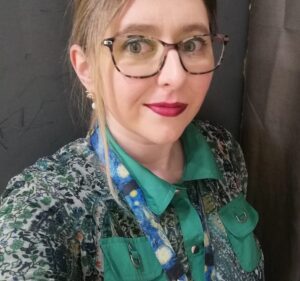
By Jané E Mackenzie
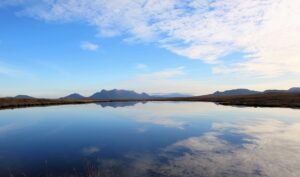
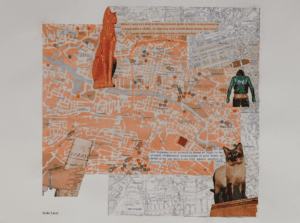
I could show you my homeland on a map and you would see the names of hills to climb and beaches to visit, but for me some of the best bits, in my experience, are vague patches of nothing on your average map. Places where you will find sheep paths, extra-squishy green bog, bracken higher than your head, and a big rock to watch a sky that is never the same colour twice. It is not surprising, given the context I grew up in, in the northwest of the Highlands, that landscape has always played a huge part in my creative practice.
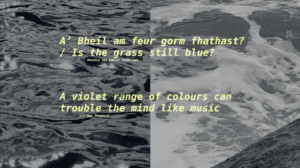
It is said that there are over 60 words for mountains in Gaelic. Landscape and Gaelic are in some way entwined, such as in the understanding of colours, which in Gaelic is beyond a hue but “distinguished by a changing landscape”.
A’ bheil am feur gorm fhathast? / Is the grass still blue?
John O’Donohue, an Irish poet whose practice was also often anchored in landscape, said:
“…one of the recognitions of the Celtic imagination — that landscape wasn’t just matter, but that it was actually alive. What amazes me about landscape, landscape recalls you into a mindful mode of stillness, solitude, and silence, where you can truly receive time.”
The desire/inability to capture the full aliveness of land, and yet continue to map it, is part of its appeal in my creative practice. Gaelic isn’t my native tongue, despite its heavy imprint on the places and people I grew up with. So it has been a wonder to read about Gaelic’s relationship to the land and to discover how this tongue, and its songs and poems, expand to me a place already known in new ways. As native speaker, John Murray, who has written two books on this topic states:
“All maps, whether drawn or not, are the product of priorities and preferences, both individual and societal. But cognitive maps confirm patterns of relative importance and patterns of movement and are understood and used by those who conceive them.”

Part of Gaelic’s erasure came through viewing the land as a means of economic gain / a commodity, as people were cleared and education systems banned its use as “uncivilised”. Driven by English colonial ideologies that treated both land and Gaelic culture as obstacles to profit and control.
At a point in my life when I was trying to find a way forward, and to make sense of why I was struggling with things others seemed to find easy, I bought a book about being dyslexic, something I was told I was from a very early age. As someone who has always consumed and existed within books, and found so much solace in them, it was strange to find such a familiar form talking about dyslexia as something so other, with the assumption that a dyslexic person would not read such a book. Pathologising in book form.
In this same period, my work agreed to pay for a dyslexic assessment. My hope was to find some of the support like I had in school, but within my context now. At the end of the assessment, it was announced that I was most likely ADHD.
With this new information, I didn’t quite know how to hold it. Like maps, and much ADHD diagnosis, it has been shaped by the priorities and preferences of individuals and society.
Again, my creative practice gave me space to relate to ADHD and neurodiversity more broadly. I made friends with people who were further along than me in understanding their neurodiversity. My friend Lizzie blew my mind with Mel Baggs video in my language (please watch if you have not) and the concept of neuroqueer (coined by Nick Walker, to Neuroqueer, is to actively reimagine the many structures that seek to define, exclude and erase us. It is to reclaim our-being and to give more full expression to our uniquely weird potentials and inclinations).
Learning about Gaelic and neurodiversity has been less about a map or diagnosis, and more about relatedness and being-ness that continues to evolve. A bit like how Nan Shepherd writes about exploring the Cairngorms at a time when most literature about mountains was written by men and aimed at reaching a summit, she created space for a more sensuous/sonorous approach and tells us that in the mountains, “the body may be said to think”.
It is a repositioning, a reimagining, reframing and for me this chimes with Layli Long Soldier who suggests that language is something to reach with — an active, relational motion rather than a fixed object.
List of references and links –
Mel Baggs – In my Language – https://www.youtube.com/watch?v=JnylM1hI2jc
Neuroqueer – https://neuroqueer.com/neuroqueer-heresies/
John O’Donohue – The Inner Landscape of Beauty (audio interview – On Being, https://onbeing.org/programs/john-odonohue-the-inner-landscape-of-beauty/)
The Living Mountain – Nan Shepherd
Reading the Gaelic Landscape: Leughadh Aghaidh na Tìre – John Murray
Literature of the Gaelic Landscape: Song, Poem and Tale – John Murray
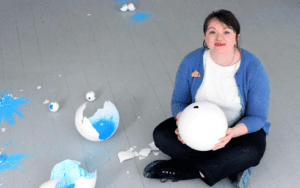
A lot of this thinking come out of my E Land https://www.janee.co.uk/p/e-land.html
Together | Apart: Celebration and Resistance
Great artists don’t magically fall from the stars. They are grown from the grassroots. It is through small, local organisations that artists can develop their practice, make connections, get inspired and access the opportunities that kickstart their careers.
Curator Amy Milner reflects on the launch of Neuk collective’s latest exhibition and the contradiction of celebrating a success in a time of instability in Glasgow’s grassroots cultural landscape.
Part 1: Celebration
Last week was an exciting milestone for Neuk Collective. After months of work and planning, we were so happy to finally open our third members’ exhibition, Together | Apart, at Glasgow’s Project Ability. This is our first exhibition in Glasgow, and we are thrilled to be expanding our reach beyond Edinburgh.
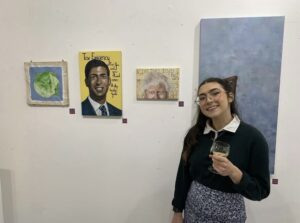
Together | Apart brings together the work of 68 Neuk Members. The exhibition explores experiences of separation and connection – and the ways these can exist simultaneously. Artists were invited to reflect on what it means to be both distinct and interwoven: separated by geography but connected through shared experience, identity and community.
First of all, I would like to say a huge congratulations to our exhibiting artists – your work is incredible and it really was a joy to curate the show. We were thrilled to see so many of you at our opening events, and we hope you all feel proud. Thank you for sharing our work with us!
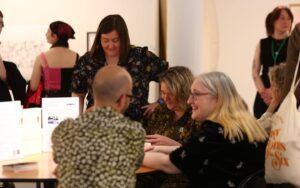
Thank you also to everyone who came along to our opening events to celebrate. The events had a remarkably relaxed and friendly feel – it almost felt like one of our ‘Create and Connect’ meetups! Looking around, I felt a deep appreciation for the community we have built within Neuk Collective and it was lovely to see so many members chatting away and celebrating each other’s work. I am truly grateful to have had the opportunity to curate Together | Apart and I am personally very proud of how the exhibition has turned out and of the growing success of Neuk Collective.

The gallery feels warm and inviting, full of rich and moving work. Of course, as the curator, I was very familiar with the work, but when we finished installing it, I was still struck by the textural depth of the exhibition. All art is a sensory experience, but it felt like there was a particular deliberateness present in the sensory aspects of these works. I don’t know whether this can be attributed to our neurodivergence, but it is evident how much care was taken by many of our artists to consider how they invited their audience to participate in the work. This came across in the feedback I heard from visitors and the fact that so many spent over an hour exploring the gallery and engaging with the art.


One of these places where people can sit down and engage with the art is our Artist Book Project.

Our Artist Book Project was an experiment in how we could collaborate on a project as a collective despite being spread all over Scotland – a way of us working together while physically apart (see what we did there?!). 43 of our members created a ‘signature’, a mini-book, expressing their own artistic vision in whatever form or media they wanted. Tzipporah and I then curated them and Tzipporah bound them together into a series of books with collaged covers. What resulted was a beautiful collection of books, as rich and varied as the larger exhibition – a mini exhibition within the exhibition! They serve as a snapshot of Neuk Collective at this moment in time.
You can explore our Artist Books here: Artist Book Project
You can see the work in the exhibition in our online gallery here: Together | Apart
Part 2: Resistance
I would like to express our gratitude to Project Ability for inviting Neuk Collective to exhibit in their beautiful gallery and for sharing their space with us. It was particularly generous of them to continue to share this space with us despite the sudden insecurity faced by the whole building, Trongate 103.
As many of you know, the site of our exhibition, Trongate 103, has been at risk of closure due to the actions of City Property and Glasgow City Council. This threatens the work of Project Ability and all the other arts organisations who are tenants in the building.
It would feel remiss not to acknowledge this situation, as my pride and happiness about the exhibition are contrasted by a deep concern for the future of grassroots arts in Scotland. Our exhibition would not exist without this space. Furthermore, the important work of Project Ability and the other arts organisations in the building would not be possible without a physical space to do it in.
The situation is ongoing, and we were heartened this weekend to hear that Trongate 103 have managed to secure another 12 months in the building, during which time negotiations will continue. This is thanks to the combined efforts of the organisations in the building and local councillors, press and activists.

While this agreement is a step in the right direction, we need to keep pushing for a long-term solution. We need funding and long-term protection for physical space in the arts. While it is expensive for funders to cover the costs of a premises, in the long run it is more financially sustainable. Otherwise, money is funnelled into the establishment of grassroots organisations, only for them to collapse when their precarious occupancy agreements are terminated. Such attitudes cause harm and erode trust within communities – how can people get invested in local culture when the places they love are shut down time and time again?
Grassroots organisations are the bedrock of the arts and culture. They are the foundation that sustains the arts. The big galleries may hold a lot of clout, but make no mistake – grassroots organisations feed them, not the other way around. In nature, innovation happens in the fringes and biodiversity is found on the edges. Grassroots organisations are the hedgerows of art and culture. We simply cannot afford to lose them.
Project Ability is one such vital pillar at the heart of Glasgow’s arts scene. Since the 80s, they have improved the lives of those they support and their families. They have increased awareness of disability art and advocated for accessible and inclusive practices. The ripple effects of this work are hard to quantify, but I’m sure they spread further than we could imagine.
In 2018, Project Ability hosted Nnena Kalu’s first solo show. In 2025, she became the first learning-disabled artist to win the Turner prize. She wouldn’t have got there without the support of the smaller organisations that supported her – Action Space and Project Ability.

Great artists don’t magically fall from the stars. They are grown from the grassroots. It is through small, local organisations that artists can develop their practice, make connections, get inspired and access the opportunities that kickstart their careers.
And producing great artists is not the only or, even, the most important output of these organisations. It is also these organisations that reach communities, particularly those communities that feel left out of larger arts institutions. They bridge the gaps between the mainstream and the people who often get excluded. They bring vibrancy to communities and enrich people’s lives.
Neuk Collective is an example of the power of grassroots movements. What started with just 4 neurodivergent artists getting together to showcase their art has grown into an established, funded organisation with hundreds of members and a staff team. We share our resources and connections; we collaborate and learn from each other, make friends and grow our careers.

So, as we celebrate the wonderful collective achievement that is Together | Apart, let us also take this as an opportunity to renew our energy, determination and fighting spirit for protecting our grassroots art scene. Let’s get inspired by the art and by each other and keep using our voices to speak up for organisations like Project Ability, whose work we cannot afford to lose.
I encourage you all to keep turning up, getting involved, and demonstrating that your local arts scene is valued and necessary. And, most importantly, keep believing that we can make a difference – particularly and especially when we come together and support each other as a community. We must remain hopeful, even in the face of great losses. If we lose hope, we lose.
So, keep fighting for the arts, keep using your voice, keep supporting each other and keep imagining a better future.
I, personally, am excited to be part of the bright future of Neuk Collective.
Once again, congratulations to our members on Together | Apart!
Stay determined and stay hopeful.
Together | Apart is showing now at Project Ability in Glasgow, until the 23rd of May.
You can visit between 11am and 5pm, Wednesday to Saturday.