Tag: member voices

The Umbrella Practice: Why Creativity Doesn’t Need One Box
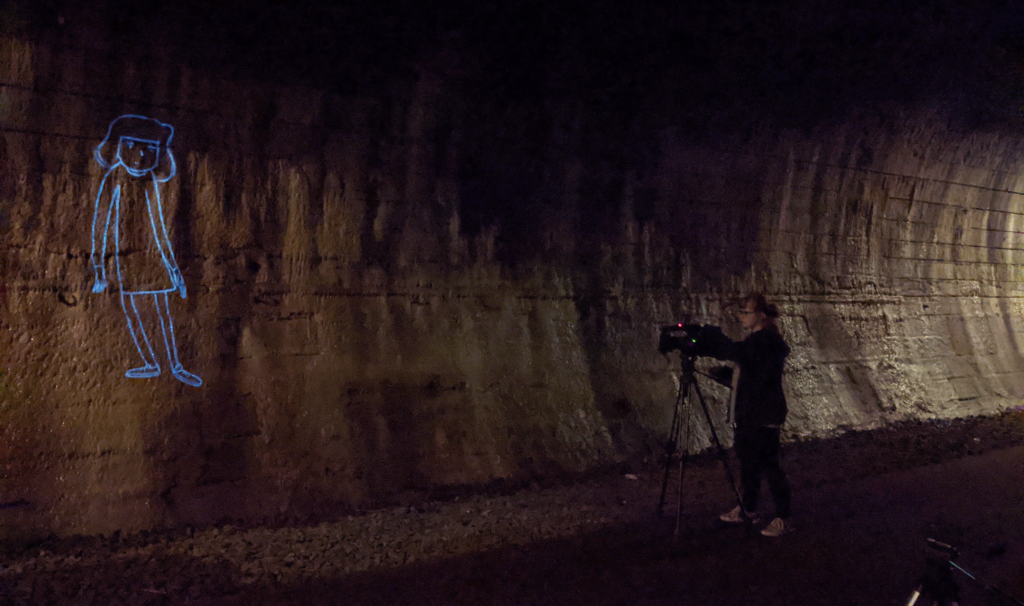
Neuk Member Dominika Jackowska on how finding your niche can be overrated.

Back when I was at university, someone said that to succeed, you should find your style, your niche, and just go for it. The idea was that if you have a recognisable style or look, people will know you for it

I tried to do that, but I have to be honest, I struggled with it. Maybe it’s because I’ve always been interested in so many different things, and it was difficult for me to stick to just one. I find many different things fascinating.

I started with animation, first traditional and then digital. At some point early on, I came across the work of MUTO, the Big Bang Big Boom animation by street artist Blu. He created animation on a huge scale using murals. It was incredibly impressive and it always stayed with me.

Later I discovered VJ Suave, a group from Brazil that creates “guerrilla animation” projections from a cargo bike. I loved the idea of making animation on a large scale and bringing it into public spaces. It felt very different from what I had been doing before.

These artists and creatives I came across really shaped my idea of what is possible.

The more you discover and the more you learn, the more your understanding of what is possible expands. I’ve always liked a challenge and trying new things. Somewhere along the way I realised I wanted to make work that brings animation into physical spaces, work that I’m excited about.

I started with animation, but over the years my practice has expanded into physical work, interactive projects, projection mapping, theatre, metalwork, and interactive installations. Animation is still at the centre of it all, but it has found ways to exist beyond the screen.

I sometimes think about creativity less as a straight path and more as a network of routes. The core ideas remain the same, but the medium changes depending on what the idea needs. Sometimes a story works best as a film. Sometimes it needs light, movement, physical space, or interaction with people.

Curiosity kept leading me into new territories.

And now I don’t mind that I don’t have one specific style. Instead, I think of my creative practice as an umbrella for exploration.

I’ve made peace with the fact that this is how my brain works. I no longer fight it, I embrace it. And this way of thinking has led me to many interesting projects and collaborations.

If you are interested in something new, go for it. You might not know yet how it will fit into your practice. Maybe not in the next month, or even the next year. But the things you learn won’t disappear. At some point they might become useful in a future project or idea.

One thing I’ve learned over the years is how important play is in creative practice.

Being a freelancer means there are many things aside from the fun, creative making that you have to deal with, such as applications, emails, planning, etc. All of those things are necessary, but they can take up a lot of your time and mental space.

That’s why it’s important to carve out time for your own making, sometimes with no purpose at all. It doesn’t have to be a huge block of time. Even 15 or 30 minutes once in a while can make a difference.

I run a lot of creative workshops, and something I’ve realised is how nice it is to attend a workshop run by someone else. Recently, I went to a sashiko stitching workshop. It was a wonderful experience to learn something new while simply being a participant rather than the person organising everything.

That’s why workshops and experimental spaces are so valuable. They allow you to make something without pressure or expectation. No brief, no deliverables, no outcome that needs to justify itself.

Just curiosity.

Those moments often reconnect me to the original joy of making.

Something I’ve noticed is that ideas rarely appear fully formed. Often they start as small experiments.

You try something out of curiosity, maybe on a very small scale, without knowing exactly what it will become.

Then months or even years later, the idea comes back. Suddenly there is an opportunity, a project, or a collaboration where that experiment finds its place and grows into something much bigger.

Nothing you learn or try is wasted. Even the smallest experiment can become part of something larger in the future.

Being a freelance creative also means living with a constant flow of tasks that exist outside the creative process.

There are applications to write, emails to send, people to contact, funding forms to complete, and budgets to plan. Projects vary between short-term and long-term commitments.

One of the hardest parts can be the feeling of never finishing your to-do list. It’s very easy to underestimate how long things take, and suddenly the day disappears into admin tasks.

Rejection is also part of the process. Applications get declined and ideas don’t always find support. Over time you develop a thicker skin and learn to keep going.

There are also moments where you’re not entirely sure what the next step is. You might not know exactly where things are heading, but you know the direction will still be creative.

Sometimes that uncertainty is part of the journey.

We are also surrounded by constant messages about productivity.

Online platforms often push the idea that we should always be improving, producing more, monetising our work, and optimising every aspect of our lives. On some level that advice can be useful, but seeing it every day can start to distort reality.

Creativity doesn’t always work on that kind of schedule.

Sometimes the best thing you can do is unplug for a while. Step away from the algorithm. Make something without documenting it or sharing it immediately.

Over the years I’ve also learned the importance of being forgiving towards yourself.

Creative life is not constant productivity. There are periods of intense making and periods that feel quieter. Times where ideas flow easily and times where everything feels slower.

We are not machines.

I’ve started thinking about creativity more like nature. A plant grows upwards, but it also grows downwards, building roots beneath the surface.

Those roots are not always visible, but they are important. In creative work, they might be learning, experimenting, observing, or simply giving ideas time to develop.

Creativity also moves through seasons. There are times of growth, when ideas flourish, and quieter periods that feel more like hibernation. Those slower moments can feel unproductive, but they are part of the process.

Just like in nature, not everything is meant to be in bloom all the time.

Often when we look at other artists or creators, we see the flower.

The finished film.
The installation.
The exhibition.
The performance.

What we don’t see are the roots beneath it, the years of learning, failed attempts, workshops, experiments, and quiet moments of doubt.

Creative work grows in both directions: upwards and downwards.

Both are necessary.

Someone once asked a simple question: Why do we make films?

There are many answers.

To tell stories.
To imagine new worlds.
To communicate something personal.
To escape reality for a moment.

All of those reasons are valid.

For me, a lot of my work is about creating moments of pause. Our brains wander constantly throughout the day, thinking about the past or the future. Through installations, light, visuals, and sensory experiences, I often try to bring people back into the present moment.

Even if only briefly.

Earlier in my career, I sometimes thought creative work had to make a huge impact to matter.

Now I’m not so sure.

If someone experiences something new through a piece of work, if a workshop sparks a new idea for someone, or if even one person walks away seeing the world a little differently, that already feels meaningful.

Impact doesn’t always have to be massive to matter.

Art and music also have a powerful way of bringing people together.

They create shared spaces, a bit like modern town squares. Places where people gather, experience something collectively, and connect through emotion or curiosity.

Film festivals are a great example of this. Watching short films from different parts of the world can widen your perspective without travelling anywhere. You see glimpses of other cultures, ideas, and ways of storytelling.

Those experiences remind you how many different voices exist.

Looking back, working across different disciplines was never really a strategy. It simply came from following my curiosity and allowing ideas to move between different forms.

Animation still sits at the centre of my practice, but it continues to evolve through new materials, technologies, and collaborations.

There will probably always be new skills to learn, new ideas to explore, and new routes that lead back to the same creative core.

And maybe that’s the point.

Creativity doesn’t need to fit into one box. Sometimes it grows best when we allow it to move freely between many.

On the importance of creativity in troubled times

When the world feels increasingly irrational and fragmented and we are facing so many crises, why is art more important than ever? 

Art and creative play can sometimes feel frivolous, especially as we’ve internalised capitalistic ideas about inherent value. Or it can seem superfluous. Surely we should be doing something more important in the face of the many crises we are facing? Sometimes it seems as though the act of creating, of making visual art, music, dance or poetry is not doing anything to help change the world.

Of course, direct actions and political struggles remain important. Protest, mobilise, do all the things! But alongside that mobilisation, and indeed within that mobilisation we need to nurture ourselves, we need to connect to each other, and we need to look for innovative solutions, and that’s where creativity is absolutely indispensable. With collaboration, reinvention, daydreaming, playing, singing, dancing, painting, and writing (indeed with any and all sorts of artistic actions) we can nourish ourselves while reinventing our present and our future, pivoting away from the neoliberal capitalist system that is destroying the planet and destroying our health.

Art is integral to humanity, it is part of us, and has been since prehistoric times, from the time of the earliest cave paintings and carved figurines. It is essential to our development. Children begin mark making at an early age, usually by the age of two. Marilyn Goodman writes that “Art is an integral activity to a child’s development. It allows children to discover, explore, experiment and learn independently… drawing with a variety of mediums encourages children to figure out how they feel about themselves and things around them.”[1] Art is how we make sense of the world, and importantly it’s enjoyable.

Yes, that’s right. Art is fun! Pleasure is important, and not something to feel guilty about. The fact that this seems revolutionary in our culture is wild to me. Let’s stop venerating suffering. Why are we on this earth if not to enjoy ourselves? I’m not talking about mindless hedonism here, which importantly is not actually pleasurable, as it leaves one with a sense of emptiness. Creativity does the opposite.

The importance of art and creativity is so huge, I feel that I could write a book on it. Maybe I will someday. For now, I will limit myself to illustrating my point with a few specific examples.

Art reminds us what we are fighting for, what a better world can look like. Iain M. Banks’s Culture series of science fiction novels describe a post-scarcity anarchist-communist society in which everyone is free to live the life that they wish to. Ursula K. Le Guin, in The Dispossessed, depicts another vision of an anarchist society, one that isn’t post-scarcity and for that reason is perhaps more relevant to where we are today. These books build worlds that feel believable, templates that we can imagine ourselves living in and can therefore work towards creating.

There are many examples of such utopias in writing and films, and of course the converse is also true, that there are many examples of dystopias. Terry Gilliam’s film Brazil, for example, depicts a nightmare of bureaucracy and state control. George Orwell’s 1984 is a book that describes a society so evocative and chilling that it has literally given us the adjective ‘orwellian’. These dystopias are critiques of the contemporary society and are also warnings as to what can happen if we remain on our present course, but importantly they are also beautiful and entertaining in the way that they evoke the imagery of their dystopian realities. We go on an adventure with the characters, we can imagine ourselves in their shoes, and we can start to recognise the parallels in the societies that we currently live in. Take warning!

Art can inform and give voice to difficult issues. Yinka Shonibare, who tackles issues of racism and slavery in beautifully patterned sculptures says, “I believe that art is not about giving instructions; it’s more of a poetic exploration… it provides a poetic lens through which we can explore and understand complex issues.”[2] Because his sculptures are so visually stunning, brightly patterned and beautiful, they invite us in, engaging us and enthralling us while giving us (and himself) a chance to consider and process the heavy and complicated issues he is referring to.

Two days after 900 people were arrested in London protesting against the banning of the group Palestine Action, Banksy installed a mural on the wall of the Royal Courts of Justice building in London depicting a wigged judge attacking a protester with a hammer. This mural clearly struck a nerve as it was immediately covered up and guarded, and later scrubbed off.[3] Ironically the scrubbed version, artistically speaking, is even more evocative than the original, as it rather proves Banksy’s point. Its shadowy form is a monument to censorship. The fact that the powers that be felt so threatened by a mural shows the importance of art in confronting oppression and speaking truth to power.

Toni Morrison talks about the threat to power that art has at great length in her 2015 essay ‘No Place for Self-Pity, No Room for Fear: In times of dread, artists must never choose to remain silent‘. She writes about feeling paralysed with depression and unable to write after George W. Bush wins the election. Then a friend points out to her that “This is precisely the time when artists go to work — not when everything is fine, but in times of dread. That’s our job!” She remembers that: “Dictators and tyrants routinely begin their reigns and sustain their power with the deliberate and calculated destruction of art: the censorship and book-burning of unpoliced prose, the harassment and detention of painters, journalists, poets, playwrights, novelists, essayists.”[4] Do you think that censorship of art would occur if art had no power to change the narrative, to change the world?

Recently, in the city of Portland in the United States, an unlikely hero has emerged on the streets: an enormous puffy frog. As the government attempted to frame protesters as dangerous and violent, Portland fought back in a very creative way. Protestors donned costumes of every kind, danced, sang, and staged tea parties in the streets. There were unicyclers and jugglers and flash mob dancers. When a protestor named Seth Todd, wearing a puffy frog costume, was pepper sprayed, the video went viral. Soon the frogs had become the symbol of the resistance.

An article in the Associated Press notes that: “For protesters like Todd, the costumes are a way of fighting absurdity with absurdity: a playful counter to Trump’s portrayal of Portland as ‘war ravaged,’ ‘burning down’ and ‘like living in hell.’”[5]

So far, these examples have examined art that is specifically and consciously political. But what about art that is not consciously political? Is it also important? I say yes, indeed I would argue that all art and creativity is inherently political, whether it seems so at first glance or not.

One powerful thing that art can do is to show us what the world looks like through different eyes, what it’s like to be someone else, how another soul lives and feels, which plays an enormous part in nurturing empathy and respect. Art can speak across different languages and cultures to connect and nurture us. A film or a painting can also teach us to look at the everyday in a new way, in the way that the artist sees it, and of course the making of art helps us to share this insight into the heart of ourselves with others. This kind of communication and empathy is a direct threat to those who would seek to divide us, for example those who demonise migrants, refugees, disabled people, neurodivergent people, queer people, and so forth.

Visual art, film, writing (if translated, obviously), and music can speak across languages, and can put us in touch with others in very different situations than our own.

Several nights ago I watched the film Un Dessert Pour Constance.[6] This is a film set in Paris which follows a pair of African immigrants who are best friends. In their job as street-sweepers they find a cookbook which changes their lives and enables them to win a large sum of money in a competition. With the money they are able to send their sick friend home and then open an African restaurant. This film brings the viewer into their lives. I experienced an intimate portrait of their friendship, of their joy and despair, of their progression from street-sweepers to restauranteurs, and the diverse society which forms around them. The protagonists are not people that I am ever likely to meet. They live in another country, they speak in a language in which I am not fluent, they live in a world which is very different to mine. And yet I now feel that I know them, at least a little. What matters to them has mattered to me. The film has expanded my empathy and my compassion for people who are different to myself.

Films that are made by people from a similar background can also spark revelations, as they show us the very specific viewpoint of the director. For example, after watching David Lynch’s film Mulholland Drive, I found myself looking at reality in a new way, hearing incidental sounds in the environment as charged with meaning. Reality itself seemed to have changed somehow, but the change had merely been in my perception. Reality had always been this strange, this beautiful, this tinged with magic and adventure. This point of view is incredibly inspiring. It opens my eyes to the magic that is all around me in my own life, and encourages me to express my own personal viewpoint, to share and connect with others.

This is perhaps one of the most important things that art can do: art creates new artists. And we need all the artists we can get. We need to hear from everybody’s specific and personal viewpoint, we need all the diversity and creativity in the world if we are to survive as a species.

After looking at impressionist paintings such as Claude Monet’s Poplars on the Epte, I find myself appreciating the way that sunlight moves through trees. This painting of some trees in France has caused me to appreciate the trees that I see every day in Edinburgh in a new way. I admire the brushstrokes, the use of light and shadow. It’s a beautiful painting, and beautiful paintings make me want to paint.

It seems possibly ironic that many of Monet’s tranquil and colourful paintings were created as a personal response to the senseless violence and death of the First World War. Monet could hear the gunshots from his studio. Fighting was taking place just 50 kilometres away, and he had family members in the army.

Painting, for Monet, was his life. It was the way he expressed himself, the way he understood the world around him, and the way he processed his emotions. He wrote, “It’s the best way to avoid thinking of these sad times. All the same, I feel ashamed to think about my little researches into form and colour while so many people are suffering and dying for us.”[7]

Should he have felt ashamed? I think not. I think it is wonderful that he responded to ugly, savage brutality with its opposite: with the beauty of the natural world. If only more people saw the world this way, the futility of war would be obvious.

Monet was also processing his emotions by painting. The power of creativity to process trauma has been well documented and has spawned the practices of art therapy, music therapy, dance therapy, and so forth. The process of creating art is known to reduce stress, to improve mental health, and to help transmute difficult emotions. Visual art can do this when words fail.

The benefits of becoming more mentally healthy are not confined to the individual, of course. Anyone who heals emotionally will have a ripple effect through the society that they live in. Healthy people are less likely to traumatise others, for one thing.

All art conveys difficult emotions, but music especially excels in this. Anyone who has ever lost themselves dancing to their favourite song while singing along at the top of their lungs can testify to this power of music: it’s cathartic. 

Not many people can listen to Beethoven’s Ninth Symphony and fail to be moved. The Ninth is famously a celebration of the interconnectedness of humankind, using the lyrics of Friedrich Schiller’s poem “Ode to Joy” in its final movement. Beethoven also overcame his own physical impairment to write the music, as he was profoundly deaf at the time. Its power is perhaps best encapsulated in a famous quote by Mikhail Bakhunin, the Russian revolutionary anarchist: “Everything will pass and the world will perish but Beethoven’s Ninth [Symphony] will remain.”[8]

Incidentally, this quote is reminiscent of a Scottish Gaelic proverb which states “Thig crìoch air an t’saoghal ach mairidh gaol is ceòl” (The world will pass away, but love and music will endure).

As I type this, I am listening to a particularly moving performance of Beethoven’s Ninth by the West-Eastern Divan Orchestra, conducted by Daniel Barenboim. This orchestra is made up of young musicians from Israel, Palestine, Syria, Egypt, Lebanon, Jordan, and Spain, as a conscious effort to bring young people together who would otherwise learn to hate and fear each other.

The proceeds from this benefit concert were donated to music education programs in Palestine.[9]

When struggling to process difficult emotions, I have always found release and comfort through punk music that expresses sheer visceral anger and joy. Operation Ivy expresses this well in their lyrics to ‘Sound System’:

Sound system gonna bring be back up, yeah

One thing that I can depend on

Static pulse inside of music bringing us escape

It’s always temporary, changing nothing in its wake

Just a second while were leaving all this shit behind

Just a second, but it’s leaving just this much in mind

To resist despair that second makes you see

To resist despair ’cause you can’t change everything

To resist despair in this world is

What it is, what it is, what it is to be free!

I’d like to take a moment to look at creativity through a specifically ADHD lens. I have ADHD, perhaps you do as well, or perhaps you know someone who does? Or perhaps you don’t and you feel that this is an irrelevant diversion, in which case please feel free to skip ahead to the penultimate paragraph. I’ll see you there.

Now, where was I? Those of us with ADHD can often get distracted, can wander down side paths when we meant to be sticking to the main one, can go to the shops for milk and come back with a solar powered blinking owl and a lifetime supply of aluminium foil. ADHD is sometimes referred to as a “superpower”, which honestly I find annoying. Losing keys, forgetting important events, double-booking, getting constantly distracted… a superpower? Please.

And yet, when it comes to creativity, ADHD really might be a superpower. We excel in pattern-spotting, innovation, and as we tend to jump in and out of obsessions we can draw on many different fields and influences. Leonardo da Vinci, that quintessential Renaissance man, is believed to have had ADHD.[10] One minute he’s inventing a helicopter, the next he’s dissecting a cadaver, then he pulls out his paintbrushes to work on his masterpiece, the Mona Lisa, endlessly refining the painting.

Our brains move at lighting fast speeds. We’ll spot connections and patterns while everyone else is still putting their reading glasses on. Our minds wander, darting like butterflies from idea to idea. Often this is seen as a negative feature — we can’t concentrate, we can’t stick to a task! But it is precisely this mind wandering that leads to greater creativity, as has recently been confirmed by a study at the European College of Neuropsychopharmacology. K.P. Lesch (Professor of Molecular Psychiatry, University of Würzburg, Germany) said regarding the study, “Mind wandering is one of the critical resources on which the remarkable creativity of high-functioning [sic] ADHD individuals is based. This makes them such an incredibly valuable asset for our society and the future of our planet.”[11]

Yay! We’re going to save the world! No pressure, my fellow ADHD creatives. That quote is a little condescending, but on the other hand it is refreshing to have our talents valued in a time in which the mainstream media seeks to demonise us, constantly talking about ‘overdiagnosis’ when the truth is that ADHD is massively underdiagnosed in the UK, and many people wait years for an assessment. (I waited 4.5 years, and I am still waiting for medication.)

We need creativity and innovation more than ever in today’s world, as we are facing multiple civilisation-threatening crises. Please, all of you, whether you have ADHD or not — express your creativity. Release your inner child. Sing out loud, move to the rhythm that you hear, play in the grass like a toddler, frolic through fields of wildflowers, create a beautiful garden, paint a portrait of your cat, play the guitar, dye your hair, design a tattoo, colour your walls bright purple, make a stop-motion animation about three enchanted magpies, recite poetry, perform a one-person opera to a squirrel, write a novel, bake a delicious cake, design a complicated hat that turns into a pillow, build sculptures out of discarded pickle jars, perform an interpretive dance — express your soul in whatever way you want to. We need you and your specific creativity and we need the art that emerges from it, to nourish us, to heal us, and to inspire us.

The expression of creativity isn’t frivolous, it’s quite the opposite. Creativity not only helps us understand and process reality, it also shapes reality. Let’s change the world for the better together, creatively.


[1] Goodman, Marilyn JS. Children Draw. Reaktion Books Ltd, 2018. p. 8

[2] “Restitution and Reflection: Yinka Shonibare Challenges Colonial Legacies”, Whitewall. https://bit.ly/3M4K5kU

[3]“New Banksy mural appears at Royal Courts of Justice”, BBC, 8 September 2025, https://bit.ly/4oHyaXv and “Banksy Mural Scrubbed from Royal Courts of Justice”, BBC, 10 September 2025, https://bit.ly/4pmjZIz

[4] Toni Morrison, “No Place for Self-Pity, No Room for Fear”, The Nation, 6 April 2015, https://bit.ly/4q7Wbbo Please, read the whole essay, it’s amazing.

[5] “How inflatable costumes ballooned at anti-Trump rallies due to a protester’s frog outfit”, The Associated Press, November 2025, https://bit.ly/4oHMC1L

[6] “Un Dessert Pour Constance”, Directed by Sarah Maldoror, France, 1981.

[7] As quoted in “Wartime water lilies: how Monet created his garden at Giverny” by Ann Dumas on the Royal Academy website: <https://bit.ly/4rIjZUT>

[8] As quoted on Classical Music dot com, by BBC Music Magazine. <https://bit.ly/48EICub>

[9] On YouTube here: https://bit.ly/48FmPT5

[10] Daley, Jason. “New Study Suggests Leonardo da Vinci had ADHD”. Smithsonian Magazine, 5 June 2019. <https://www.smithsonianmag.com/smart-news/new-study-suggests-da-vinci-had-adhd-180972359/>

[11] European College of Neuropsychopharmacology. “New research reveals how ADHD sparks extraordinary creativity.” ScienceDaily. ScienceDaily, 13 October 2025. <www.sciencedaily.com/releases/2025/10/251012054608.htm>.

On Writing and Neurodivergency

Neuk member Elspeth Wilson interviewed other neurodivergent writers reflecting on how it influences their craft.

When neurodivergent writers are interviewed or spoken about, there’s often an emphasis on their process. How and when do they write, do they have a routine, how does their neurodiversity impact that. And whilst this is all valid, interesting and potentially useful for other writers, there’s a lack of discussion about how neurodiversity impacts writing craft. As neurodivergent authors, we have so much to offer in terms of form and craft as well as representation and process – although perhaps neurodivergent style can be thought of as a kind of representation in and of itself.

“In writing horror, my neurodivergence is a massive gift,” explains Lucy Rose, best-selling author of The Lamb, a folk horror cannibal novel that explores mother-daughter relationships. “My relationship with textures makes me want to crawl out my skin.” As neurodivergent people, we often notice – and are potentially horrified by – small details such as flickering lights, the wrong shape of spoon or a clothing label rubbing against our back. Rose uses these everyday experiences to create a kind of creeping dread; it’s not so much transforming the mundane into the terrifying, but foregrounding the terror that already exists within it.

“The trick to writing good horror is that you don’t show the monster but you let us feel it”, Rose says – a sentiment that will be familiar to many neurodivergent people who are haunted by sensory issues that others may not even notice. And it’s not just horror where noticing small details enriches writing. Tom Newlands points out that “being autistic makes you very interested in the world, and in people, and very driven to learn.” In his literary coming-of-age novel, Only Here, Only Now, Newlands builds a rich sensory world in a coastal town in 90s Fife. “All that information that you take in over the years, paying attention to things, it accrues, and what you end up with is a picture of the world that is more advanced; richer and more multi-faceted – more overwhelming at times, too.”

As Rose notes, “there’s a huge misconception that people who are neurodivergent don’t feel empathy as much.” But for many neurodivergent people this couldn’t be further from the case. “I’m very curious about other people’s feelings,” Rose says. “I’m constantly trying to understand the people around me which is a really taxing pursuit.” And although it might be draining, it can allow a writer to get into the minds and feelings of their characters, including those who have different characteristics to the author.

Whilst this is a necessity for all writers, anyone who has been brought up in a mainstream culture that doesn’t cater to their needs arguably has a headstart on relating to and empathising with a whole range of characters. Because the fictional characters we grew up with were almost never (openly) neurodivergent, we’ve gotten used to both decoding neurotypical characters and empathising with those who are different from ourselves.

That said, neurodivergent characters may not always be legible or likeable to neurotypical audiences and that in itself offers something to a literary landscape where there’s a focus on likeability, particularly for female characters. In my debut novel, These Mortal Bodies, the main character, Ivy, makes dubious decisions driven by her fervent desire to belong when thrust into a glittering yet treacherous world at a prestigious university. For some readers, this might make Ivy unpalatable – and of course it’s every reader’s prerogative to have their own opinion on a book. But I believe my neurodiversity helps me write characters who are nuanced and complex, observant and watchful because I grew up studying and imitating others out of necessity. A character doesn’t have to be relatable or like the reader to be a good character or to offer them something. The ‘outsider’ main character has long been a method of giving a reader a way into a story – and neurodivergent writers are ideally placed to understand and interpret this feeling.

For Natalie Jayne Clark, author of the sapphic crime novel The Malt Whisky Murders, her own way of experiencing and thinking about the world directly influences the voice of her novel, told in first-person by the main character, Eilidh. Like Clark, Eilidh has ADHD, and the author describes it as “natural” for her protagonist to “take us through their thoughts and rationale in a similar way. There might be an image, detail or tangent that doesn’t initially make sense or feels unusual, but then we can see how her (or my) brain has connected the two.” Again, neurodivergent writers are writing against the grain of characters being instantly understandable to readers – and offering creative richness in the process.

Many writers write to make sense of their experiences and this can have an extra dimension for neurodivergent writers who are navigating a world that wasn’t made for them. Marcia Hutchinson, author of The Mercy Step which explores the life of a young girl in 1960s Bradford, describes her writing as autofiction; “I write about my own life, not just because I’ve had a relatively long and eventful life, but because I want to try and understand why I have behaved the way I have in so many circumstances.” This way of excavating one’s own emotions and behaviour will be familiar to many neurodivergent people; it allows Hutchinson to act almost like a detective of herself and transform her own experiences into fiction. She explains that “often with the benefit of hindsight I can see that I took people literally when they were speaking figuratively but I was unable to distinguish between the two.”

Neurodivergent writers also often approach language itself in particular ways. The main character of Newlands’ novel, Cora, is a teenage girl whose voice is immersive and lively throughout the book. “One of the reasons I chose to write in the voice of a teenager was because it would allow me to be playful,” he says. “There was scope for slang, brand names, compound words, weird spellings.” This was partly to entertain the reader “but most importantly keep my brain interested.”

Hutchinson, who has ADHD, also notes that she has to work on exactly what she’s drawn to at the time: “I would be terrified to get a two book deal because the pressure of having to write book two would do me in.” The tendency for many neurodivergent brains to get bored quickly can produce writing that is extraordinarily varied and imaginative at a sentence level as well as in relation to story and character.

Neurodivergent people are increasingly visible – often as political scapegoats – and whilst there’s been greater representation in recent years thanks to fantastic novels such as A Kind of Spark by Elle McNicoll, our visibility can come at a high price. In the arts world, neurodivergent writers are still often pigeonholed or tokenised. But there’s a burgeoning, hugely varied neurodivergent canon out there which should be taken seriously on its own merits. We may still be the outsiders looking into a neurotypical (literary) world but that allows us to rebel, experiment, play and see things in interesting, insightful ways – even through the barriers that are placed in our way.


Elspeth Wilson is a writer and poet who is interested in exploring the limitations and possibilities of the body through writing, as well as writing about joy and happiness from a marginalised perspective. Her debut novel, These Mortal Bodies, comes out in paperback on February 26, 2026.