
Emily Cropton
In this blog post, artist Emily Cropton reflects on sustainability, land stewardship and creative practice through the lens of the Tweed catchment. Drawing on personal experiences of walking, making and gathering materials, she explores how environmental thinking can shape the way we understand our relationship to land, community and resources.
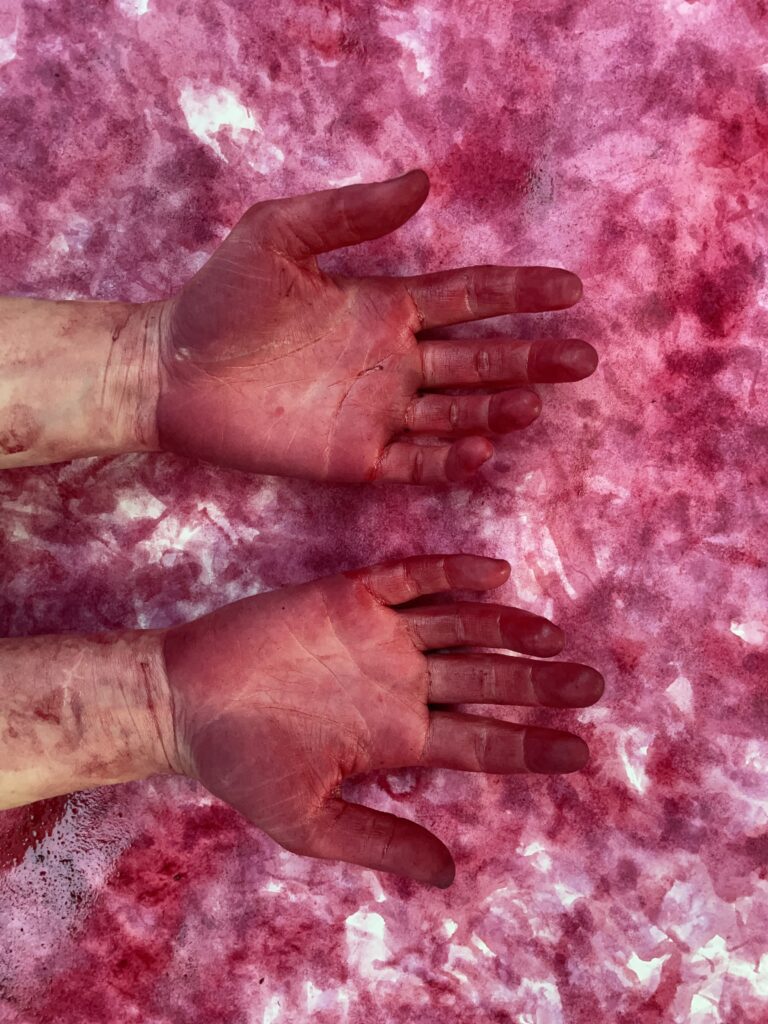
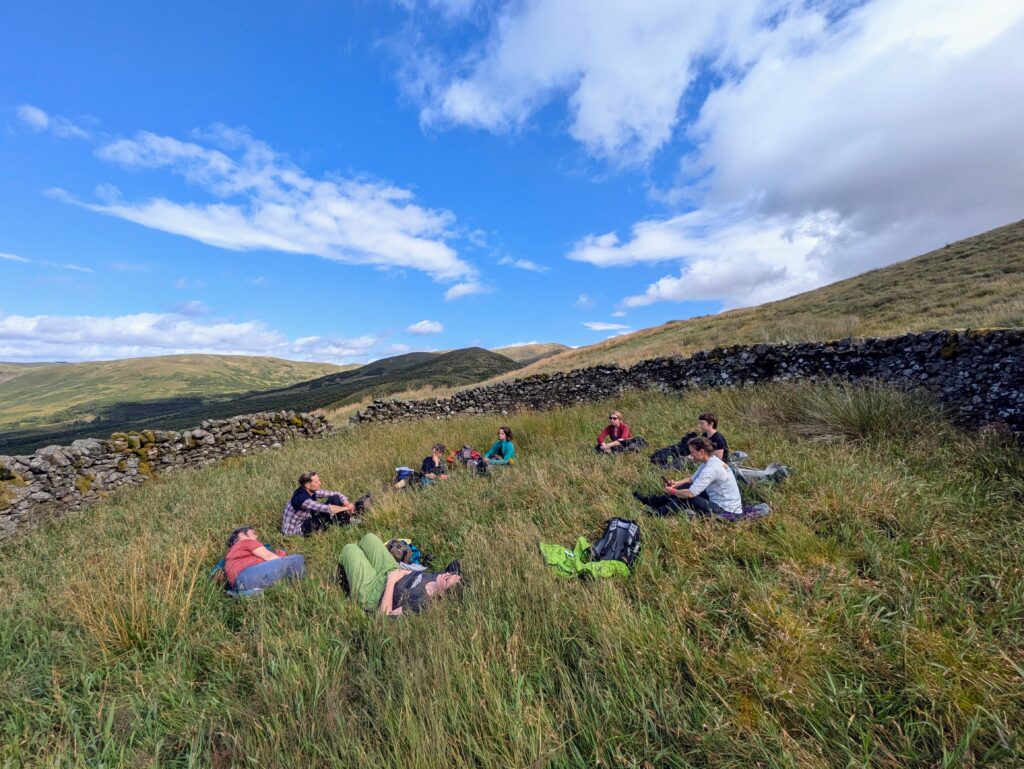
I’m kneeling awkwardly on the lower, south-western slopes of Coldburn Hill, a small, ordinary looking hill in The Cheviots in north Northumberland. It’s late August but my hands are cold and I’m hungry, having eaten all my food after the half hour drive and three mile walk here. I’m picking bilberries, small blue berries which grow in abundance on this kind of moorland and are an important foodstuff for birds, insects and mammals. Later, I will use the berries to create a dye to colour my late Grandma’s old bedsheet, and use this to make a costume, part of a residency exploring disappearing land management practices.
As it turns out, I didn’t quite pick enough berries and so a week later I walk to Sainsburys and buy a packet of frozen blueberries to top-up my dye pot. The blueberries are ‘Packed in the UK’ but their origin is unspecified. Back home I tip the berries into the pan and put the plastic bag into the recycling bin. I think the berries I picked by hand were more sustainable, but it feels hard to know for sure.
Pictured: Blood Berry, 2024 – Photo credit Emily Cropton
On paper, defining ‘sustainability’ is deceivingly straightforward – ‘a way of using resources that can continue forever’. Yet when the word is pulled from its sheet of recycled wood pulp, it starts to shape shift, through political promises in White Papers and paper-thin advertising campaigns. It loses its roots, tossed about like a paper aeroplane, weightless and directionless.
To only use resources at the rate at which they can grow or be regenerated feels sensible, logical. There is something neat about it. I once read that the UK uses resources at a rate that would only be sustainable if there were 2.6 planet earths. The need to use less is inevitable, but I need another way of thinking about it to really make the idea tangible.
For six years I have lived and worked in the Tweed catchment, the second largest river catchment in Scotland after the Tay. A river catchment is the area of land in which all the water drains into the sea via a single estuary. In my case this is the Tweed estuary at Berwick-upon-Tweed, the English town across the border from my home where my studio is located. A river catchment is defined by its watershed, the ridge of higher ground that separates one catchment from another. The Tweedsmuir hills lie almost 100 miles west from Berwick and between there and here the river carries nutrients, seeds, waste and dead animals out to sea before the hydrological cycle rains the water back down again. Through living here and traversing this landscape I have come to think about the catchment as a body. A body both contained by its form and porous to other bodies.
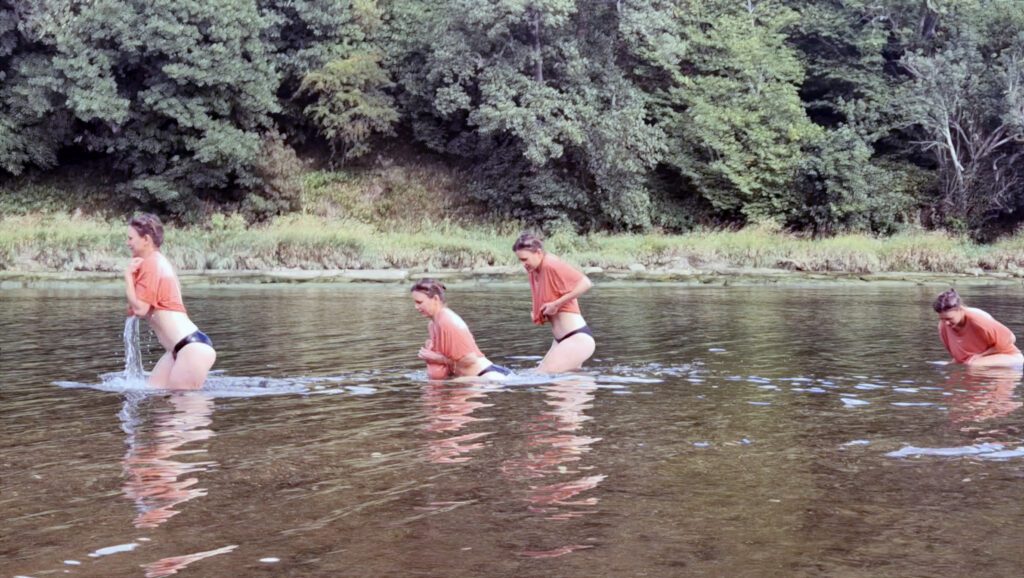
The catchment provides a conceptual and physical framing and acts as a yardstick in my work, which navigates between the intimacy of the human body; the places, ecosystems and communities that I encounter when walking; and the global economic and political decision making that shapes these things from afar. Moving between these scales, reaching my hand from the dye pot to the biberry bush to the frozen berries of unknown origin, to the environmental stewardship scheme that prevents this particular hillside from being used for forestry plantation, edges fray and seams leak. The cycles we were once intrinsically tied to are unravelling, our social connections to them faltering. This is where my work lies, in the tangled mess of it all.
Using materials that I have found or been given can lead to aesthetic choices in my work that sometimes feel awkward or uneasy, yet I have always aspired to the make-shift arrangements found on farms and places far from shops where there is an idiosyncrasy and efficiency to their ‘design’. I find these arrangements, which sit so unselfconsciously in the realm of the functional, almost inseparable from art. I try to resist the idea that what I make might become precious, more precious than any other object I own, and instead consider the work like this: as just another assemblage of materials, shaped through labour and time, to express a function or idea, often temporarily. The expression of the things I make is different to the farmer’s mended trough or a whipped together stile, but I question if it is any more important.
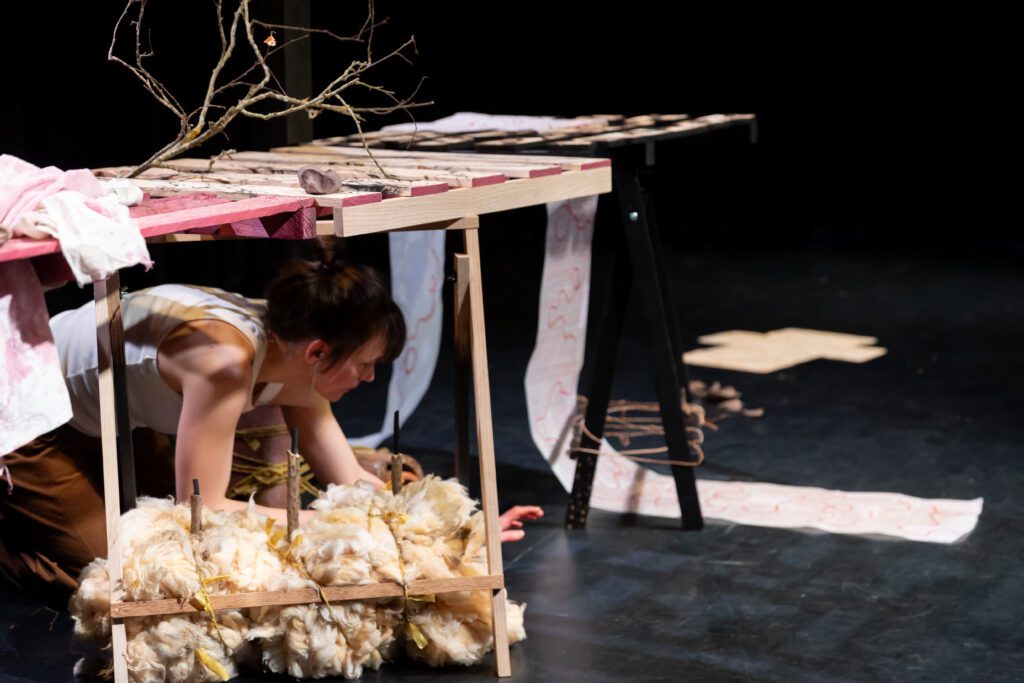
My studio is a 2.5m x 4m rectangular room. It has a door and a window and is in a leaky old building. Like the catchment, it is porous and is a place where materials collect. Re-using materials from one project to the next frames making as an act of transformation rather than production – over-dying or over-printing onto fabric already used, melting wax crayons gathered on one project to create waxed canvas for the next. Work is pushed out the door to be shared (through performances, workshops, exhibitions, walks) before being pulled back in and transformed again.
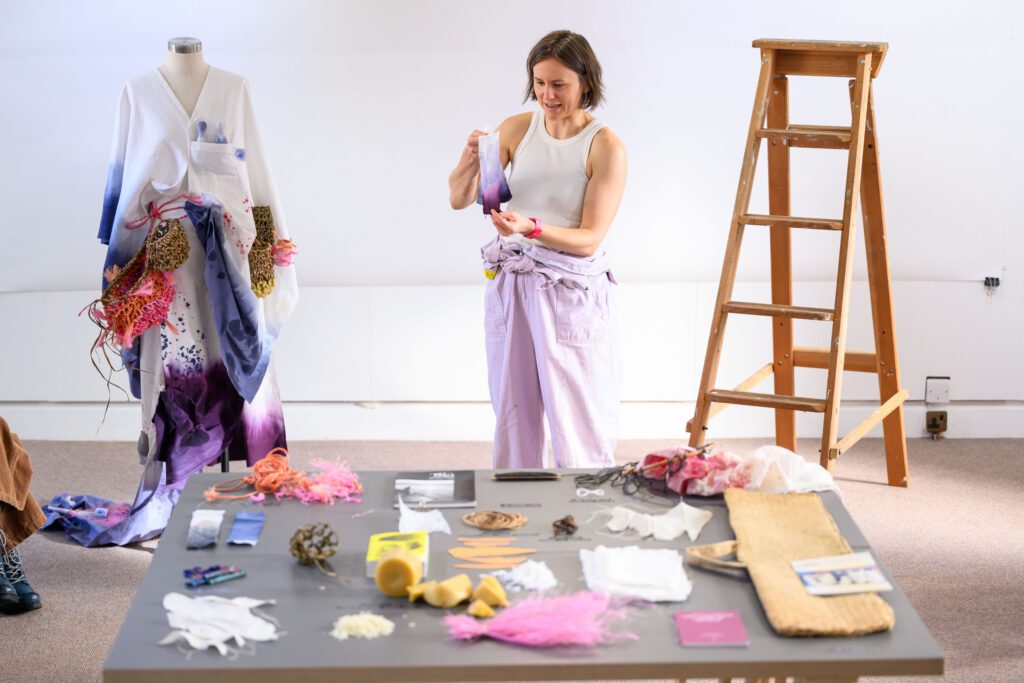
In funding applications I am often asked what the outputs of my work will be. In electronics, the technology that enables me to apply for funding, an output is described as ‘a place where power or information leaves a system’. I don’t want the energy or information to leave my system, to leave my catchment. I want to hold onto it, or at least re-use it for something else. I want to make work that involves other people and is shared with other people, but temporarily, for a short while, until it is reborn into something else.
This blog post was written for Neuk Collective as part of our Sustainability Season, August -October 2026.
Find out more about Emily and her practice at www.emilycropton.com.